Latest News

Meat Mates Freeze Dried Dog Food Review


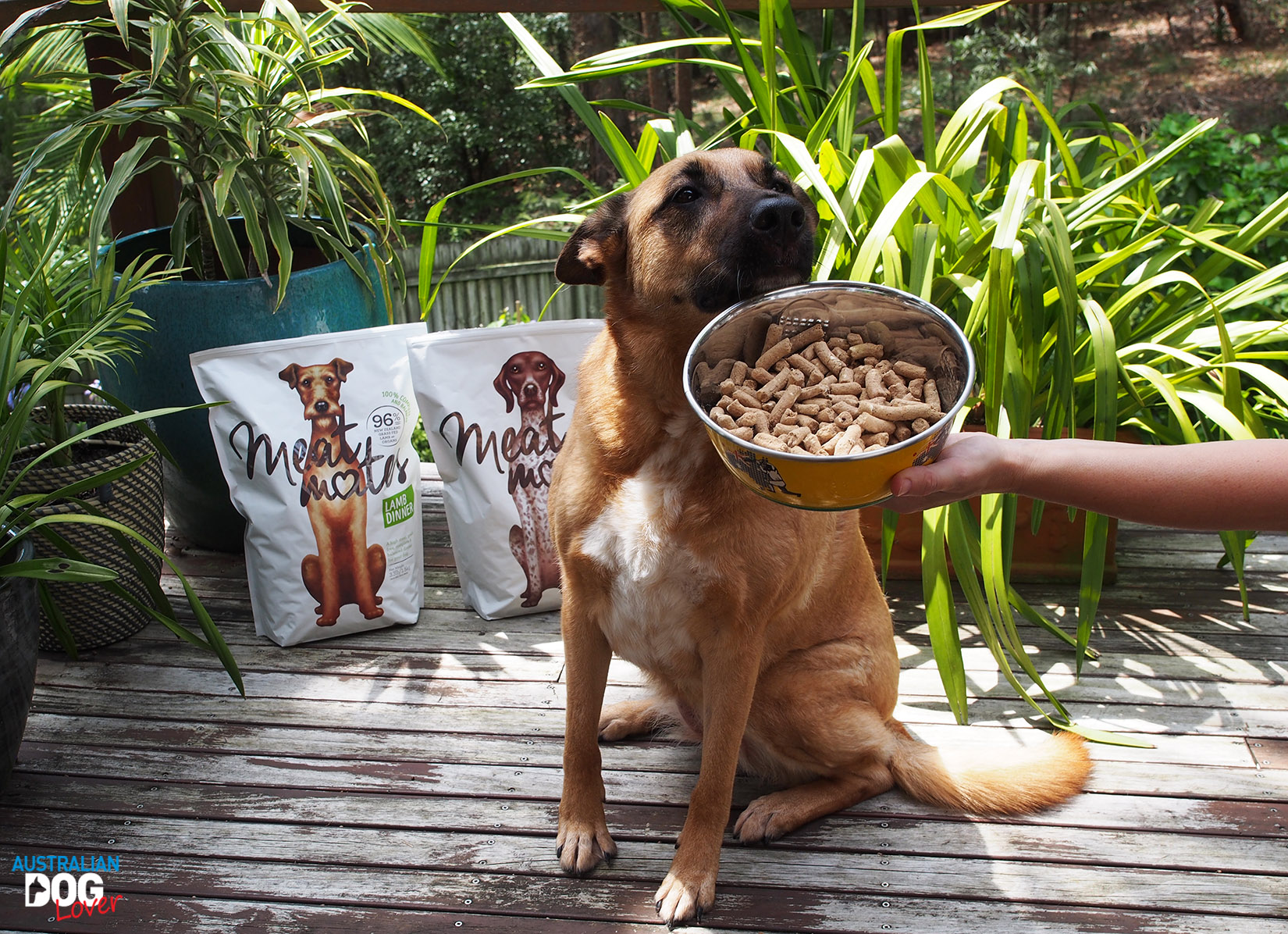
Over the past month our lucky puppers tucked into the Meat Mates range of freeze-dried dog food and wet food cans.

In line with customer trends, this brand embraces the “keeping it simple naturally” concept.

When selecting a new dog food for our Malinois (even for a trial) our main criteria is that it must be free of all fillers and preservatives and use only high-quality natural ingredients

Personally, despite the controversy we’re not overly concerned whether our dog food is grain-free, but high-quality entire proteins must be at the top of the ingredients list.

A bit of background about Meat Mates

Despite being launched in 2018, we can’t say we’d heard of this New Zealand brand (Christchurch-based) until late last year. Meat Mates belong to the Natural Pet Food Group, also behind the more well-known K9 Natural and Feline Natural range.

The Meat Mates dog or cat food options are versatile so you can use these for a complete and balanced diet, a booster option sprinkled on their normal food or as a treat.

The brand’s strategy taps into human consumption trends of high protein, grain-free and traceability, creating an offering that is simple and makes sense to pet owners. 


Swapping animal meal for real New Zealand meat, and gelling agents for a humble splash of water, it is no wonder cats and dogs go crazy for the taste.

The Meat Mates Dog Food Range

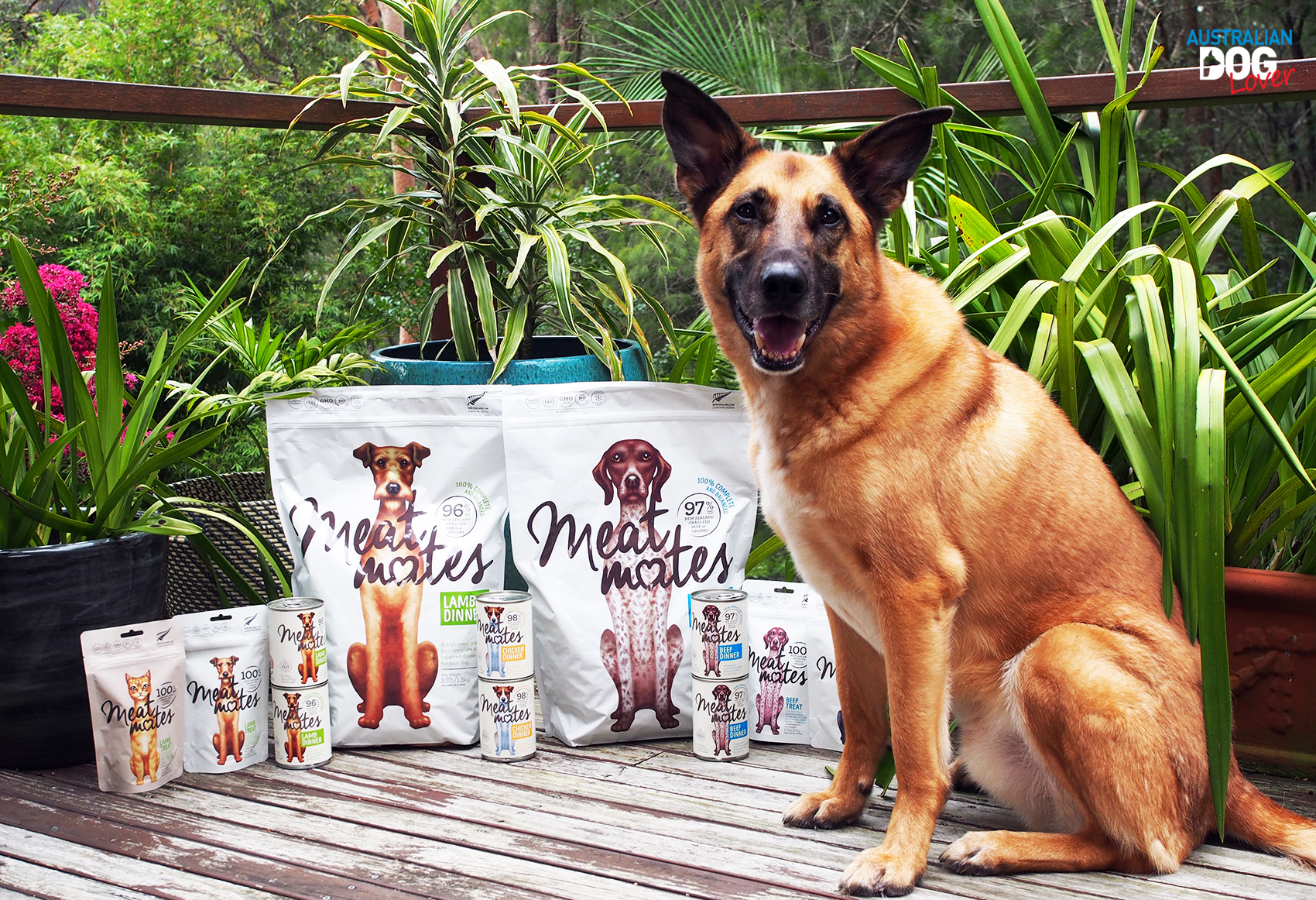
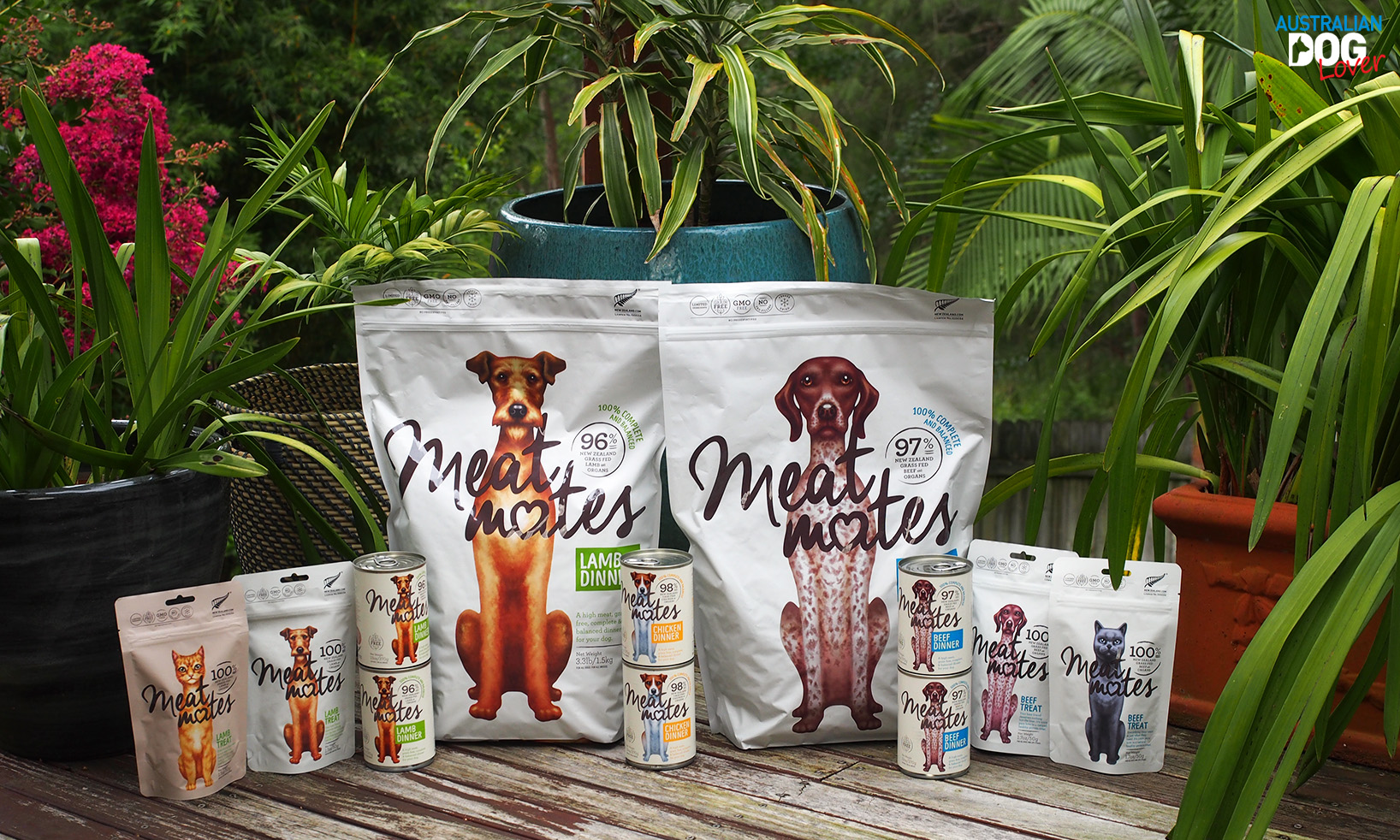
Meat Mates produce a range of freeze-dried single source meals (these can be used as toppers) and treats. They only use sustainably farmed New Zealand free-range grass-fed meat (beef or lamb) and cage-free chicken.

They understand that the better life animals live, the better the meat tastes. Since we now order our own meat direct from the farm, we can't disagree both from an ethical standpoint or when it comes down to taste!

With a focus on single source protein (96% - 97% meat and organs) meals, Meat Mates only add ingredients that serve your four-legged friend's health, whether it is adding Fish Oil and Rosemary Extract for an antioxidant boost and a shinier coat, or adding vitamins and minerals to deliver a complete and balanced diet.

When you focus on selecting premium ingredients, you avoid the use of fillers, preservatives, artificial colours and flavours.
By freeze drying their products they also lock in the natural colours, flavours, smells and the meat's nutritional value.

Another bonus - not to be overlooked when you've been locked up in your home for months on end - is the long shelf life (2 years from the date of manufacture) so a great option to have on standby! Bags should ideally be stored out of temptation's way on a cool dry space like a cupboard. Once opened, we recommend removing and disposing of the oxygen absorber to reduce the risk of accidental ingestion by your pet!


Meat Mates Beef Dinner, Lamb Dinner or Chicken Dinner are formulated to meet the nutritional levels established by the AAFCO Dog Food Nutrient Profiles for all life stages excluding the growth of large size dogs (32kg or more as an adult) so this may not be suitable if you have a giant breed puppy.

Meat Mates also have a range of treats, made from single source New Zealand grass-fed, free-range meat or cage-free chicken. These treats are high in meat and protein, low in carbs (grain free) and guilt free as they contain no unnecessary fillers or preservatives.

As with the freeze-dried dinners or wet food cans, these come in a range of delicious flavours including chicken, beef and lamb to suit both dogs and cats.

We'll focus only on the two varieties our dogs sampled over the course of the past few weeks and for those who like the nitty gritty, we included the full nutrients/calorific profile:

1) Beef Dinner: (97% NZ grass-fed beed and organs)
  • Protein Minimum: 41%
  • Fat Minimum: 37%
  • Fibre Maximum: 1.5%
  • Moisture Maximum: 8%
  • Ash Maximum: 11%
  • Omega-3 Minimum: 0.5%
  • Calorie Content ME (Calculated): 5008 kcal/kg or 175 kcal/cup

2) Lamb Dinner: (96% NZ grass-fed lamb and organs)
  • Protein Minimum: 42%
  • Fat Minimum: 42%
  • Fibre Maximum: 1.5%
  • Moisture Maximum: 8%
  • Ash Maximum: 7%
  • Omega-3 Minimum: 0.65%
  • Calorie Content ME (Calculated): 5683 kcal/kg or  170 kcal/cup

How much to feed your dog/s?


As with every food, it will depend on your dog’s weight, energy requirements (sedentary, working dog or anything in between) and your current weight goals. So always keep in my mind that an individual dog’s requirements may vary by +/- 50%!  If your dog is either overweight or under weight, you really need to consult with your veterinarian to develop a dietary plan that suits your pooch - especially with a medical condition.

Whether you’re feeding the Meat Mates Dinners as a complete balanced meal or a booster, the daily feeding guides are easy to follow. If you’re offering your dog(s) any treats that day, just remember to adjust accordingly!


If this is your first time using freeze-dried dog food, you’ll probably be surprised by its appearance - it presents as small pellets - and amazed by how light it is (so easy to pack for a holiday or camping trip) so you’ll use volume rather than weight to portion it out!

In our experience the Beef Dinner presented in smaller pellets (this could have been a result of transport as some were very crushed) than the Lamb Dinner variety (anything from 0.5cm to 3.5cm). 

If you have a small dog, those are pretty easy to crumble in your fingers, or you could use a fork to mush after adding a little bit of water (warm works a lot faster but remember to let it all cool down before offering it to your dog).


For both the Beef Dinner and the Lamb Dinner, the same feeding quantities apply:

✔️ For our large dogs (over 26kg), we would use 4½ + cups daily as a complete diet and only ½ cup as a booster.

✔️ For a small dog (5-10kg), you’d only feed 1-2 cups daily as a complete meal or ¼ cup as a booster.

Our overall verdict on the Meat Mates range

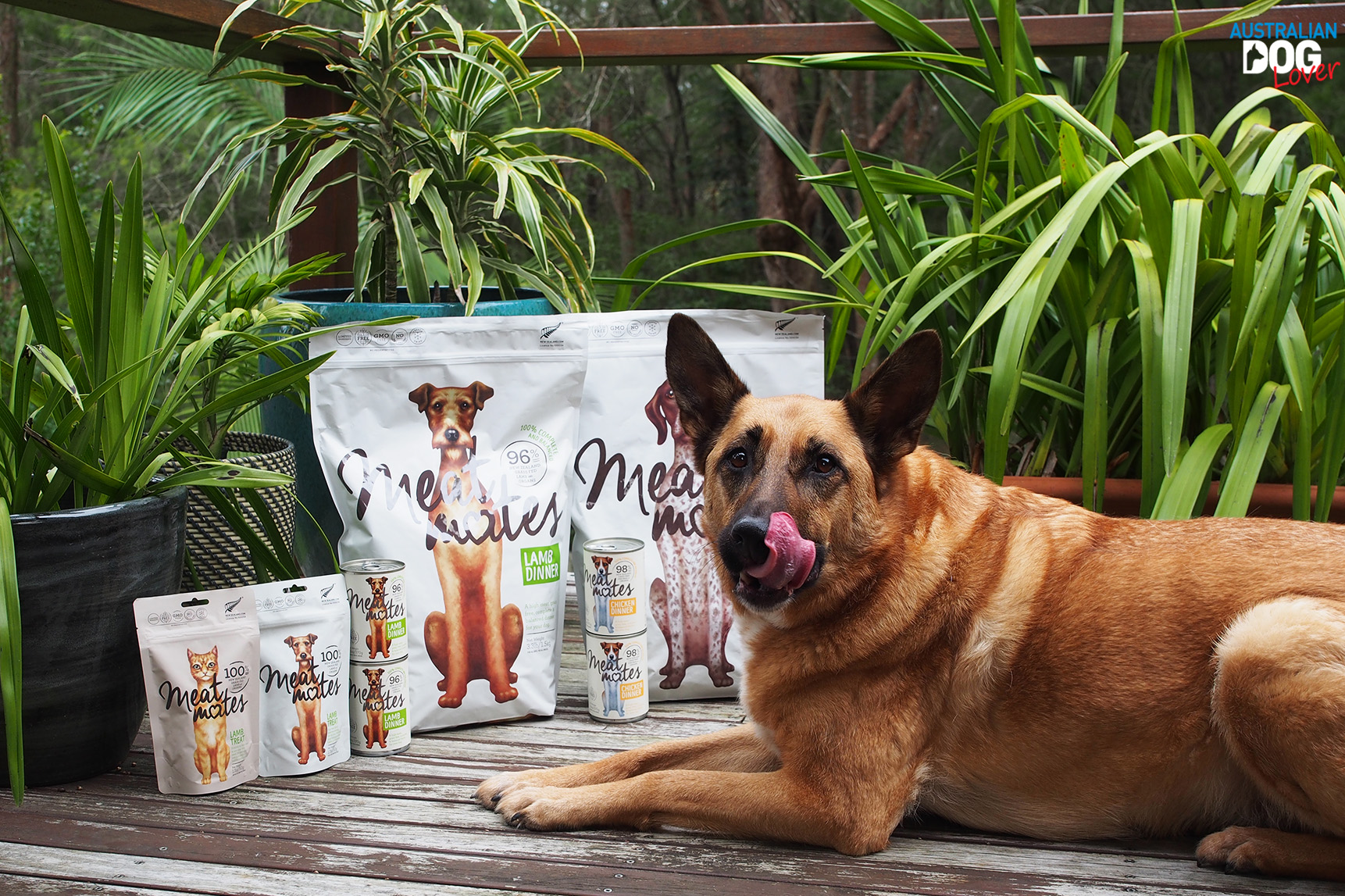
Our last freeze-dried dog food review goes back 5 years so we were initially apprehensive (thinking we'd need to rehydrate and let the food sit for a few minutes prior to feeding), but both the Meat Mates Beef Dinner / Meat Mates Lamb Dinner were a huge hit with our dogs (dry or wet – which was our choice to provide more hydration during this hot summer!).
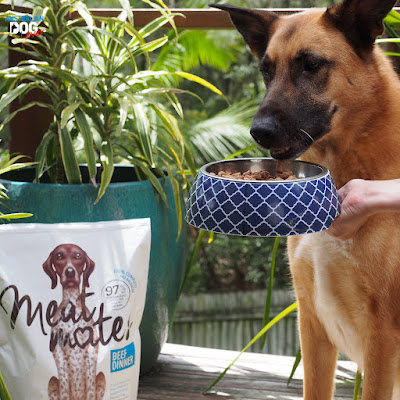

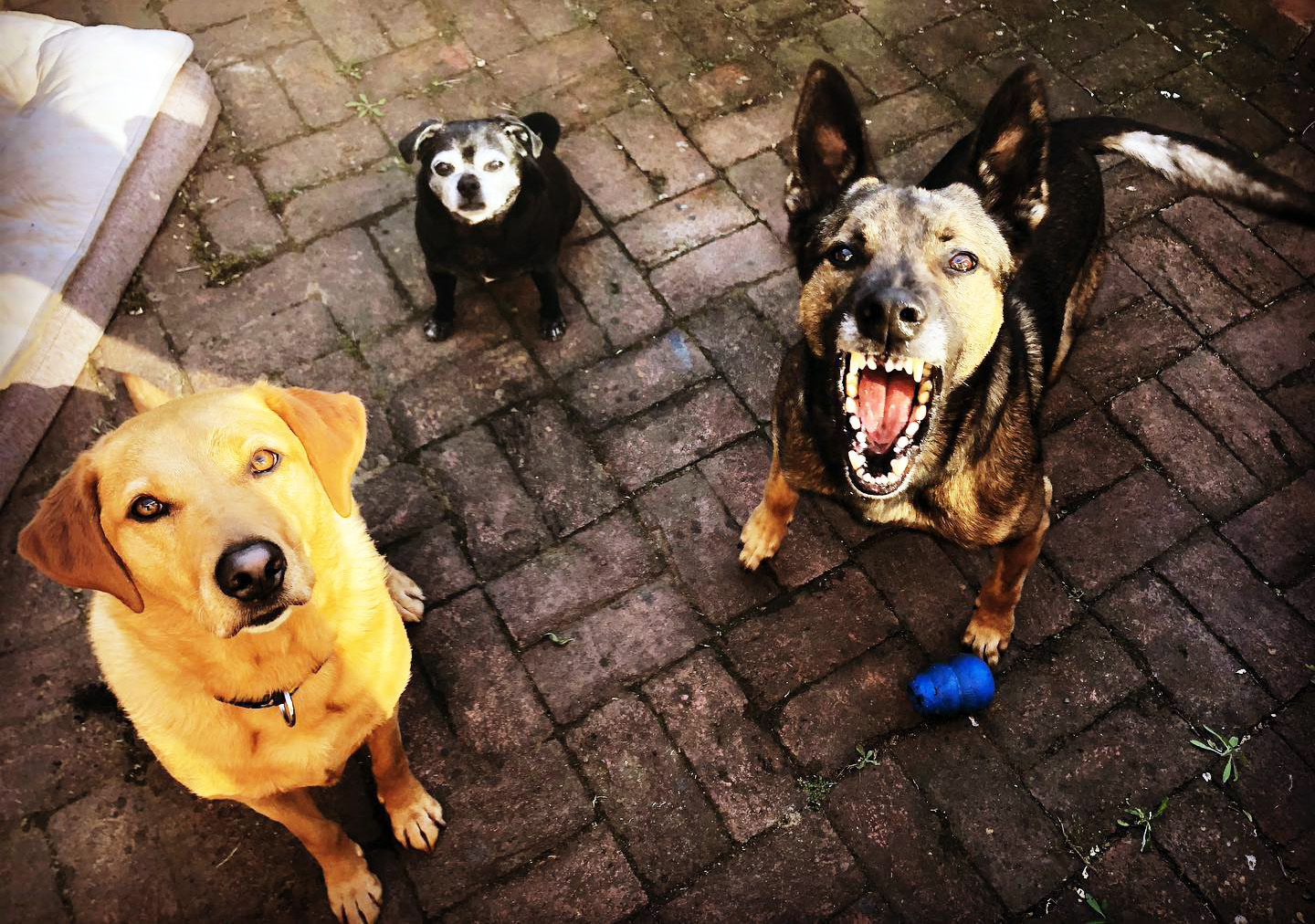
Porthos was looking forward to his Beef Dinner 
We honestly don’t think our dogs had any favourite between the Beef Dinner and Lamb Dinner varieties as they polished off every 
single bowl put in front of them.

We are told that freeze-drying also kicks the flavour up a notch, so it's perfect for tempting fussy eaters. If you're worried about your dog liking the texture, you can get your paws on small size bags (130g) to try all the flavours.

Our nose is clearly not as fine-tuned as our dogs’ but the Beef Dinner was definitely very fragrant, it was a hit even with our cat Arya! We only served her a very small amount as a treat but she was soon lining up at the same time as our dogs both morning and night for her “crummies” (we’d crumble the Beef Dinner pellets in our fingers before feeding these).

If you have a feline companion, Meat Mates offers a Meow Dinner range for them with the same varieties but formulated specifically for cats, which is definitely worth exploring if you have a fussy eater like ours!

Last but not least, we also trialled some of the canned varieties 
(Lamb DinnerBeef DinnerChicken Dinner) with success! These are available in two sizes (370g and 170g).


We admit that we rarely offer wet foods to our dogs (or cat) because of the low percentage of protein (only 7.5% - 8.3%) so these cans were used mainly as toppers with a few spoonfuls added to their freeze-dried regular meals.

Only on the hottest summer days, did they eat a full can as an evening meal, which made for a low-calorie but very hydrating dinner (e.g. 81.5% Moisture for the Beef Dinner Canned - 83% for the Lamb Dinner Canned). You may not be into this but the best part for our dogs was the jelly-like coagulated fat on the bottom of the cans!

Price & Where to Buy:

In Australia, Meat Mates was available from large online retailers like Pet Circle, Pet House Superstore and Amazon.com.au as well as Coles supermarkets.

Please Note: Meat Mates has made the decision to remove freeze-dried cat and dog food from their portfolio (June 2023).

To learn more, please visit www.meatmates.com

Disclaimer: We received complimentary 1.5kg bags of Meat Mates Lamb Dinner and Beef Dinner and 12 x 370g cans (Lamb, Beef, Chicken) in order to complete this review.

updated 13th June 2023

Woodlea's Bloomville Dog Day Out - February 5


Pamper your pooch at Woodlea and Sugar Republic’s doggy day out

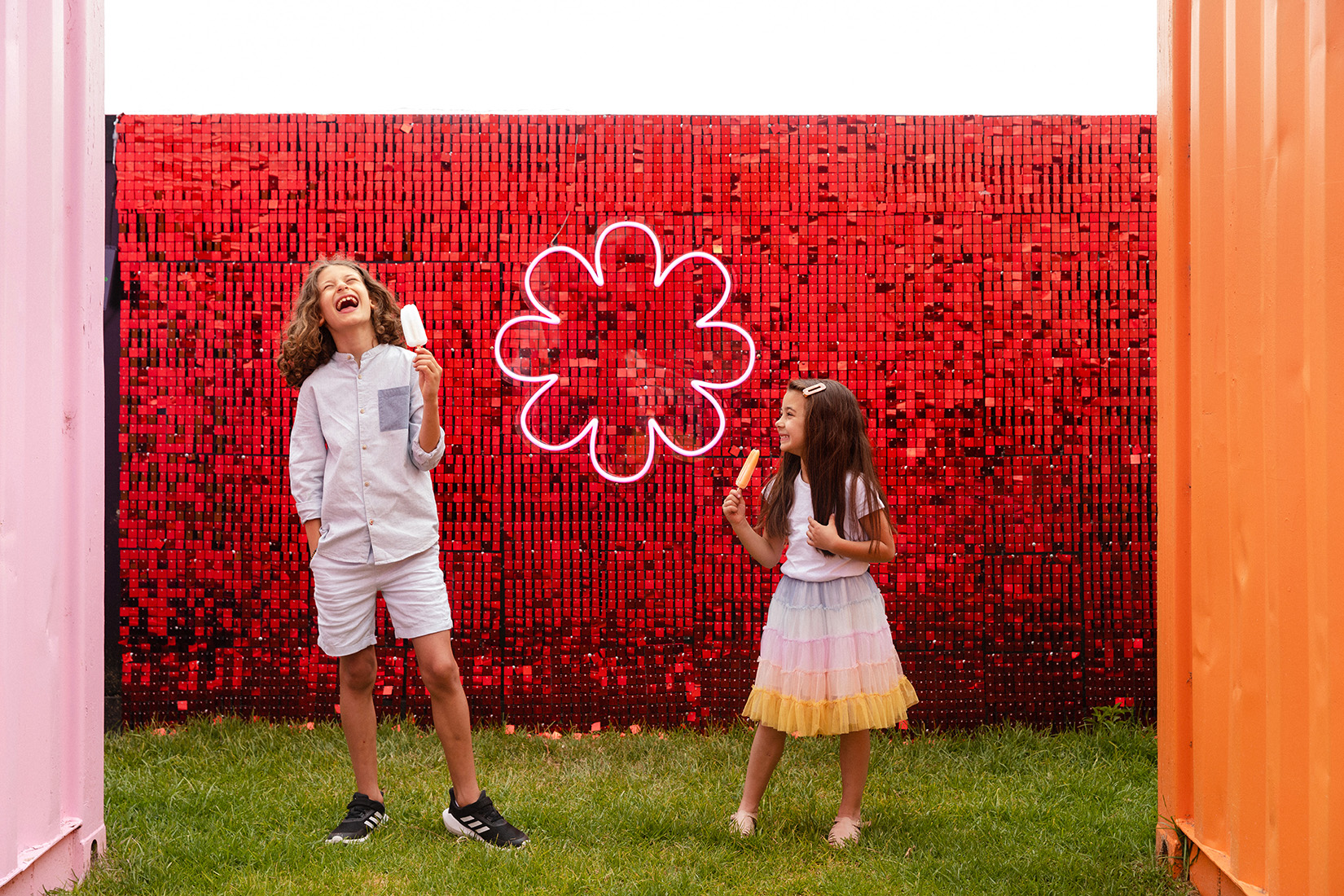
On Saturday February 5, Woodlea in Melbourne’s west is inviting four-legged friends to its large-scale Sugar Republic activation known as Bloomville, for an exclusive doggy day out!

Pet owners are invited to bring their pooch to pose and primp amongst the colourful shipping containers made in the signature Sugar Republic style, brought together by outdoor play spaces to bring a smile to all.

The journey begins by spinning the Weather Wheel, followed by the rainbow playground which leads into a series of colour-blocked, neon-lit spaces. 

Each room opens the door to a world of colour and fun with a super bright mural from Melbourne artist, Kate Pullen, providing the perfect photo moment for pooches.

From a topsy turvy flower power bedroom to planting a little happiness, Bloomville is full of colourful and fun activities that will see visitors making a wish and playing rainbow ping pong - all with their four-legged friend in tow.

What’s more, all ticket sales on the day ($5 per dog / $5 per human) will be donated to Lort Smith Animal Hospital.

To celebrate raising over $10,000 within less than a month, Bloomville has also extended its dates until the end of February, meaning there’s still a whole month to experience the fun that awaits!


As part of Woodlea’s vision to become Australia’s healthiest community and to leave a lasting legacy, Bloomville seeks to raise funds for a handful of local charities, while providing Woodlea residents and visitors alike with some much needed colour and fun, following the trying past two years.

Bloomville is located at Woodlea Town and will be open until February 28

For more information, please visit woodlea.com.au/bloomville/

Tickets can be purchased via https://www.eventbrite.com.au/o/bloomville-36387229023

About Woodlea

Woodlea is a fully integrated master-planned community by Victoria Investments and Properties (VIP) and Mirvac, designed to provide wonderful homes as well as opportunities including employment, education, retail, commercial and community services. Spanning 711 hectares, Woodlea is a major asset for the west, comprising prestigious schools, ‘destination style’ playgrounds, parks and sporting facilities and is home to a large-scale Town Centre with a Coles.

Woodlea is currently home to 8,500 residents and upon completion, will effectively be a ‘mini-city in the suburbs’ with approximately 20,000 residents.

About Sugar Republic

Sugar Republic is Australia’s first pop-up museum. Launching in Melbourne in 2018 (at the former chocolate factory where the Cherry Ripe and Freddo were created), it successfully toured Australia for 2 years prior to COVID, activating in vacant retail spaces, car parks and warehouses and attracting a strong following for its unique blend of art gallery and themed attraction. Created for young adults, millennials and families, this interactive experience encourages its audience to relive the joy of childhood through over-sized food art, crafted nostalgic backdrops and old-school play. 

Other popular installations by the Sugar Republic team have included Christmasland and The Museum of Love, and they recently opened The Sweet Retreat, a sugar-themed Airbnb in Daylesford, Victoria.

MEDIA RELEASE, 31st January 2022

7 Key Principles of How Dogs Learn


Emma is the human face behind Muddy Pawz, the home of Fit-Dog Training
®, a dog business all about truffle detection, fitness and dog obedience with all kinds of fun in between.

Emma has been a professional dog handler for over 10 years. When Emma and her 'fur faces' are not truffle hunting or training, she works in law enforcement so with this wealth of experience and exposure, of course she has seen all types of dogs and their needs. All dogs are different and as such, require dog trainers who can think outside the kibble box!
Dog training is kind of like building LEGO® with no instructions.
As you build the pieces up, sometimes it's the wrong piece and you need to take some steps back and find the piece that fits just right! It can also be like stepping on a Lego brick so make sure you bring your patience hat!

Emma is here to help give you some tips on how to become the next Lego master! (She means train your dog to their needs!!).

These are the key principles to training your dog in simple Emma terms. 
If you can understand and apply these principles then you can train a dog.
"If you don’t want to read about it then please enjoy my incredibly bad drawings and have fun with it.. The most important thing to remember is to have fun.. Please do not bore your dog! Dogs become easily distracted.. Squirrel... And when they are distracted, they do not learn and this leads to frustration and conflict. 

Leave conflict at the door! If your dog listens and has fun learning for 2 minutes then end it there. Trust me that’s better for your dog than 10 minutes of frustration.

#1. Engagement

Having fun is the easiest way to become engaged with your dog. Having your dog engaged in training is super important. 

Engaged means to have your dog's full attention and interest. You must be the most exciting thing in your dogs world at that moment in time. If your dog is looking elsewhere and not listening to you then your training will be ineffective. 

✔️ You need to find ways to get your dog engaged, play games and use treats or toys to get your dog engaged. 

✔️ Start training in a very neutral place like your own backyard: your dog has already sniffed around here numerous times and isn’t going to be distracted. 

 
✔️ Put your dog on leash so that there is no chance of a run away because this can lead to confusion and frustration, the evil enemies of dog training! 

✔️ I will often stand on the lead so that both hands are free.

✔️ Training sessions need to be short and often, not long and drawn out. You need to remain enthusiastic and make it fun, let's be honest.. No one wants to play if there’s no fun!

✔️ Be the person your dog wants to hang out with!
By the way, I have a T-Shirt that says exactly this so it must be true...

#2. Command

The command is the word and/or signal we give our dog to let him/her know what response we want

The command must remain consistent every time to ensure that your little buddy doesn’t get confused. Use what works for you but don’t forget what word or hand signal you used.


Don’t repeat the command over and over thinking your dog is hard of hearing, otherwise your dog will think that when you want him/her to sit they must hear “SIT SIT SIT” before they have to give you a response because they associate the numerous commands rather then the word itself. 

Just say it once and wait.

If they need help, then apply a gentle touch to the back end of your dog to help guide them in to position if its a sit or use food to help lure your pooch by placing in front of your dog and raising it slowly above your dogs head, allowing the dog to naturally go backwards and into a sit position.

#3. Association

Dogs learn through association, its almost like an equation they solve in their mind that goes a little something like, command = response/reward

You’ll note that response and reward are equal to each other. That is because they must occur together for association to take place. 

For association to be effective the reward must be timely with the response. This mean that if your dog sits you need to be rewarding as your dog's butt hits the ground. 

Timing can be improved by marker training your dog
This is where you teach the association of a reward with a clicker/word (I use 'YES'). The dog will hear the click/word and will eventually associate that as if it were the reward itself. 

The purpose of the marker is so that as a mere human we are able to get timing more consistent and accurate. 

We can say the word 'YES' faster than we can get a piece of chicken to our dog. I’ll say it again, for association to occur, timing is everything.

We also need to be mindful that our dogs can associate places or other constants that occur when training takes place, so once you are confident that your dog knows how to perform the command in one area, mix it up a little and move locations, perhaps another room of the house in the early stage to keep distractions to a minimum until your you and you dog are ready to start training around distraction.

#4. Reward

Rewards vary for every dog because no two dogs are the same. 


Some dogs need an amazing reward like chicken while some dogs are happy to work for a simple bit of praise or a cuddle.

To ensure that your dog is keen to work, you need to find what your dog loves, the better the reward the more your dog will be keen to work for it. 

I wouldn’t be far wrong in saying most dogs love chicken or a toy, but for this to be effective the reward must also be timely so that your dog will associate the reward with the action. 

This means that the dog is rewarded at the time they respond to the command, not just after or before but at the time of the response.

#5. Repetition

Dogs don’t understand what we’re saying and it’s only through consistent repetitive commands and rewards that a dog will learn what we are saying. 

It is important that our commands remain a consistent tone each time we command our dog to give a response. This must be performed over and over again for our dog to understand. 

I don’t mean that you should command your dog for hours on end, this simply means that over time the same command must be used repetitively

Dogs learn in short sharp sessions so don’t spend hours trying to teach your dog anything at one time. Small sessions for a few minutes numerous times a day is best.

It’s also important not to let your dog or yourself become bored. Try having a game between some commands so that the time you spend together training remains fun and not a constant barrage of commands. 

It takes time for your dog to learn but it will take a lot longer if your dog doesn’t enjoy the training time.

#6. Patience

Make sure you bring your patience hat because you are going to need it! Dog training can quickly become frustrating if you are not cool calm and collected. 

If you feel frustration creeping in to your training session then walk away.. Seriously, step away now.. 

Play a game instead, this will make you both start to have fun again and perhaps swallow the chill pill you needed to get back in to some training or leave it at that until later or another day.


#7. Correction

Corrections should be used once you know your dog understands a command. Just like the reward the correction must be timely and relevant to the dog. There are many ways a dog can be corrected, it doesn’t have to be harsh it has to be relevant. Your dog may have a toy they love that you take away and they don’t get it back until they do what you’ve asked. 

Again all dogs are different and some may need a time out others may need a verbal ‘NO’ and others may require it to escalate to a check with a chain. 

Always start with a low level of correction to find what makes your dog tick. 

When giving a verbal correction mean it when you do it, be firm. Your dog shouldn’t be let off for poor behaviour or disobeying a command otherwise this will become the norm for your dog and they’ll think its ok to do what they want. 

It can also become confusing for you little mate when one minute its ok to not listen and the next you are correcting him/her, this just isn’t fair on your dog, so if you give a dog a command always back it up and make sure your dog follows through and if they don’t then correct the behaviour."

written by Emma McPherson, Muddy Pawz, January 2022 for Australian Dog Lover (all rights reserved).

About the writer

If you want to know more about Emma and her dogs, please remember to check out their adventures on their social channels.

Instagram: @muddypawz_k9 

If working dogs are of interest to you, Emma and her pals also have a YouTube channel and Podcast called “The Top Dog Show” where they talk about all types of dog jobs around the world and of course have lots of fun!

Instagram: @thetopdogshow
Apple podcast: The Top Dog Show

For more information on dog training sessions and merchandise, visit www.muddypawz.com.au

Greyhounds Living in Harmony with other Pets


Sunday 20th February is Love Your Pet Day. Started in 2013 to show further appreciation for pets, Love Your Pet Day will be observed worldwide on 20th February 2022.

To celebrate this special day, the Coalition for the Protection of Greyhounds (CPG) asked Greyhound owners who also have other kinds of pets to share their stories with us. What we were told was both heartwarming and inspiring.

While hundreds of Greyhounds cohabit harmoniously with other breeds of dog, including small ones such as Chihuahuas, CPG also heard from many people about Greyhounds living happily with other species, especially cats.

Greyhound Charlie with Beans the cat (left); Greyhound Anubis with Sid the cat (right)


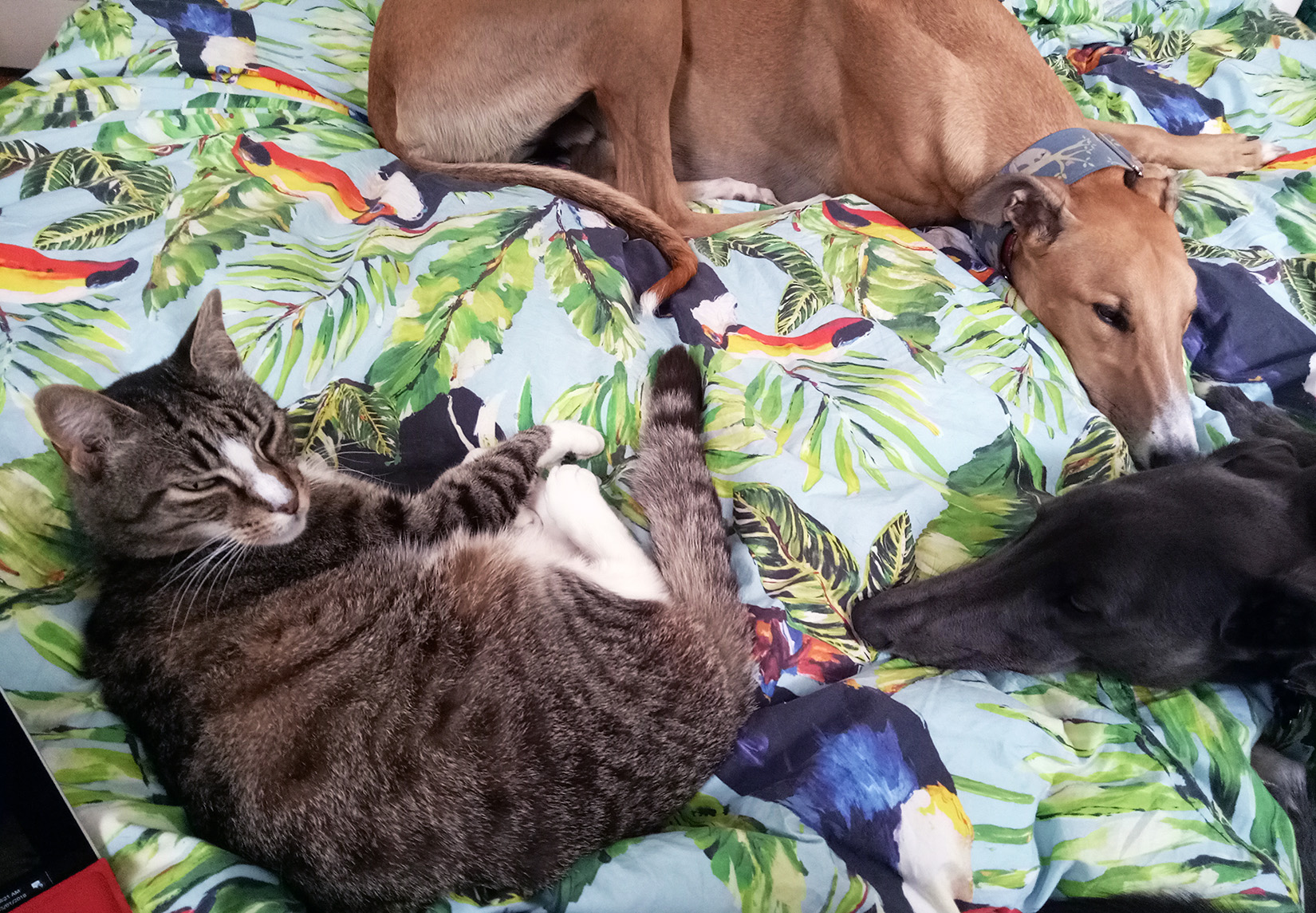
Not all greyhounds will be comfortable with cats, although some adopt a peaceful ‘live-and-let-live’ arrangement with them, like Charlie from Tasmania has, with a very timid cat called Beans. 

Other Greyhounds, like Anubis, also from Tasmania, develop close, even playful, relationships with cats. Anubis loves playing chasings in the hall with Henry the cat, or lying around having his ears cleaned by another cat called Sid.

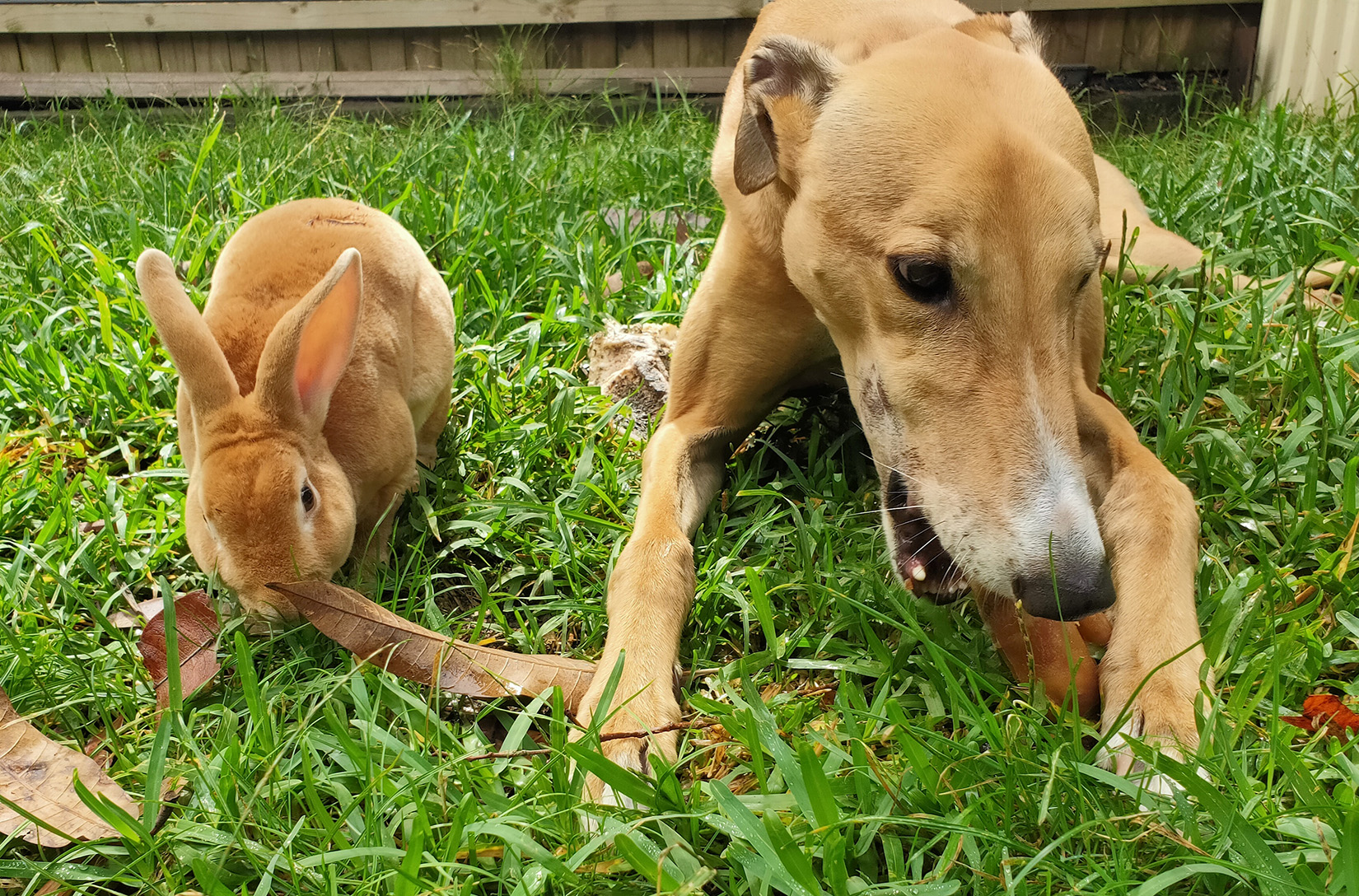
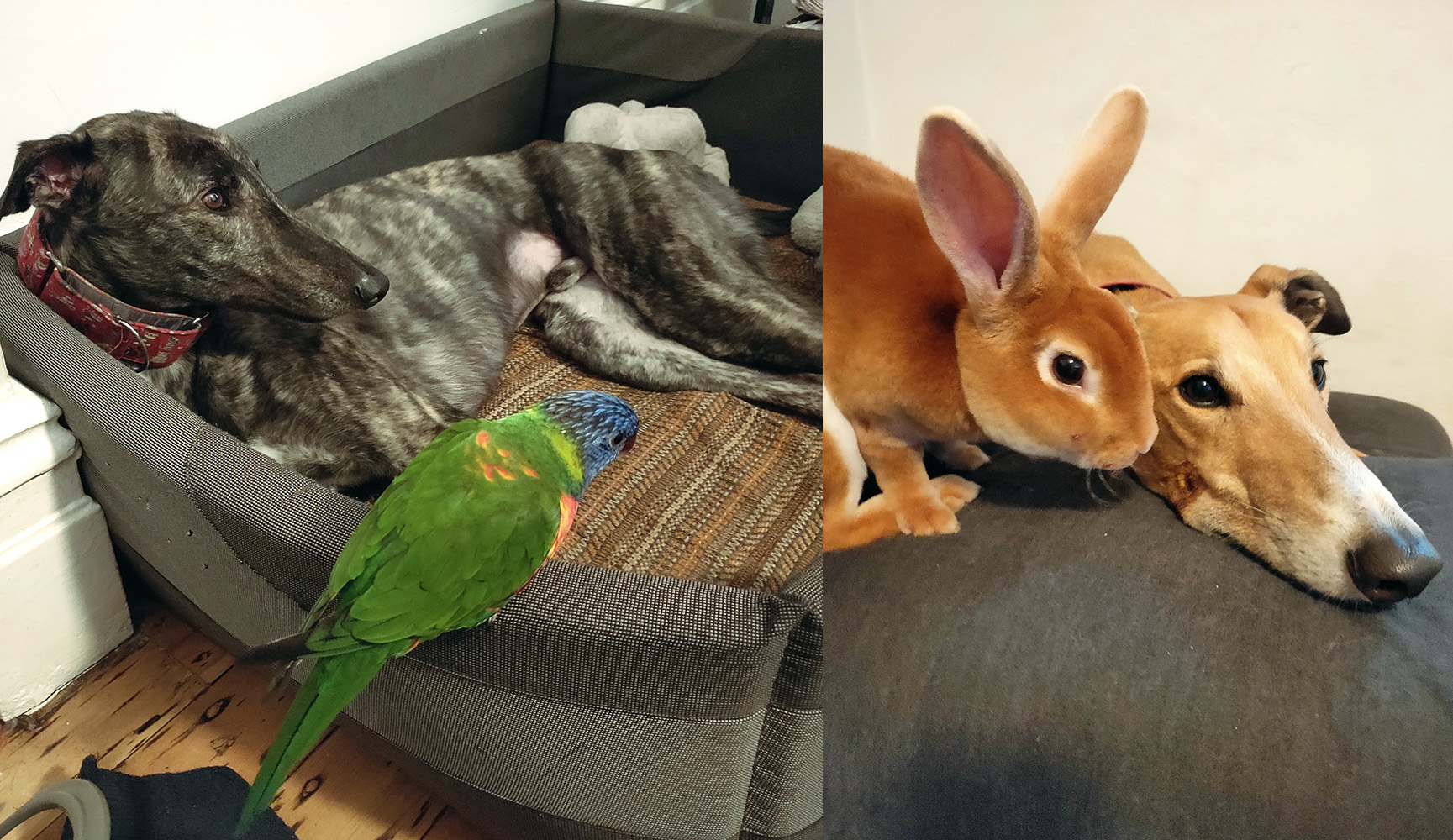
Frankie from NSW is a ‘long dog’ who loves all animals including cats, rabbits and a lorikeet. 

Greyhound Frankie and his bunny friend eating the grass together
His owner said she once left him with a kitten nestled into his belly. Later when she called him, Frankie didn’t come. She found him still lying with the kitten, reluctant to move while the kitten was still cuddled up with him.

Frankie’s fellow Greyhounds, Toby and Sadie also live happily with the same household menagerie and they’re not alone in living in harmony with birds such as chickens and cockatiels.

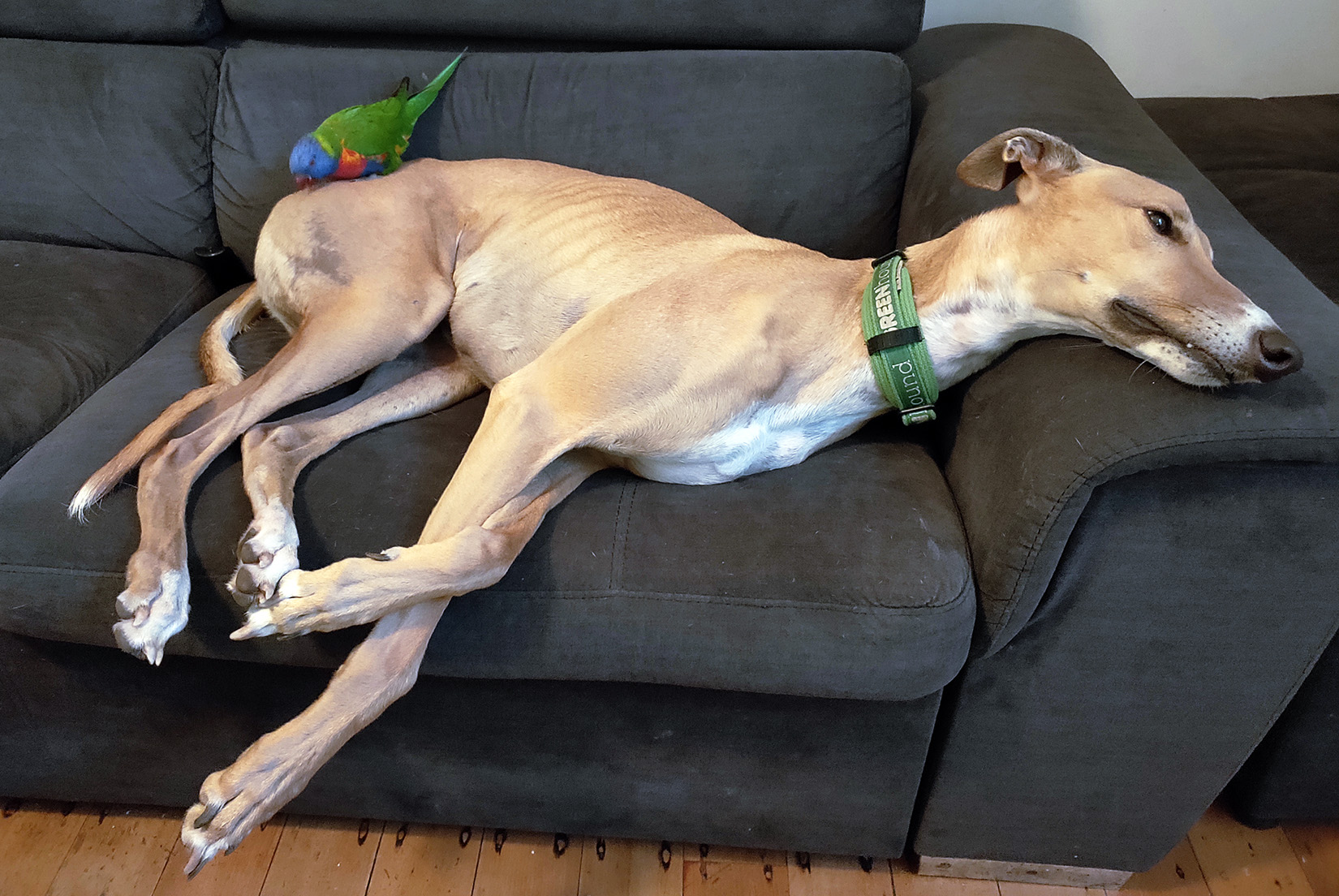
Toby hangs out with a lorikeet on the couch (left); Frankie loves a bunny cuddle (right)


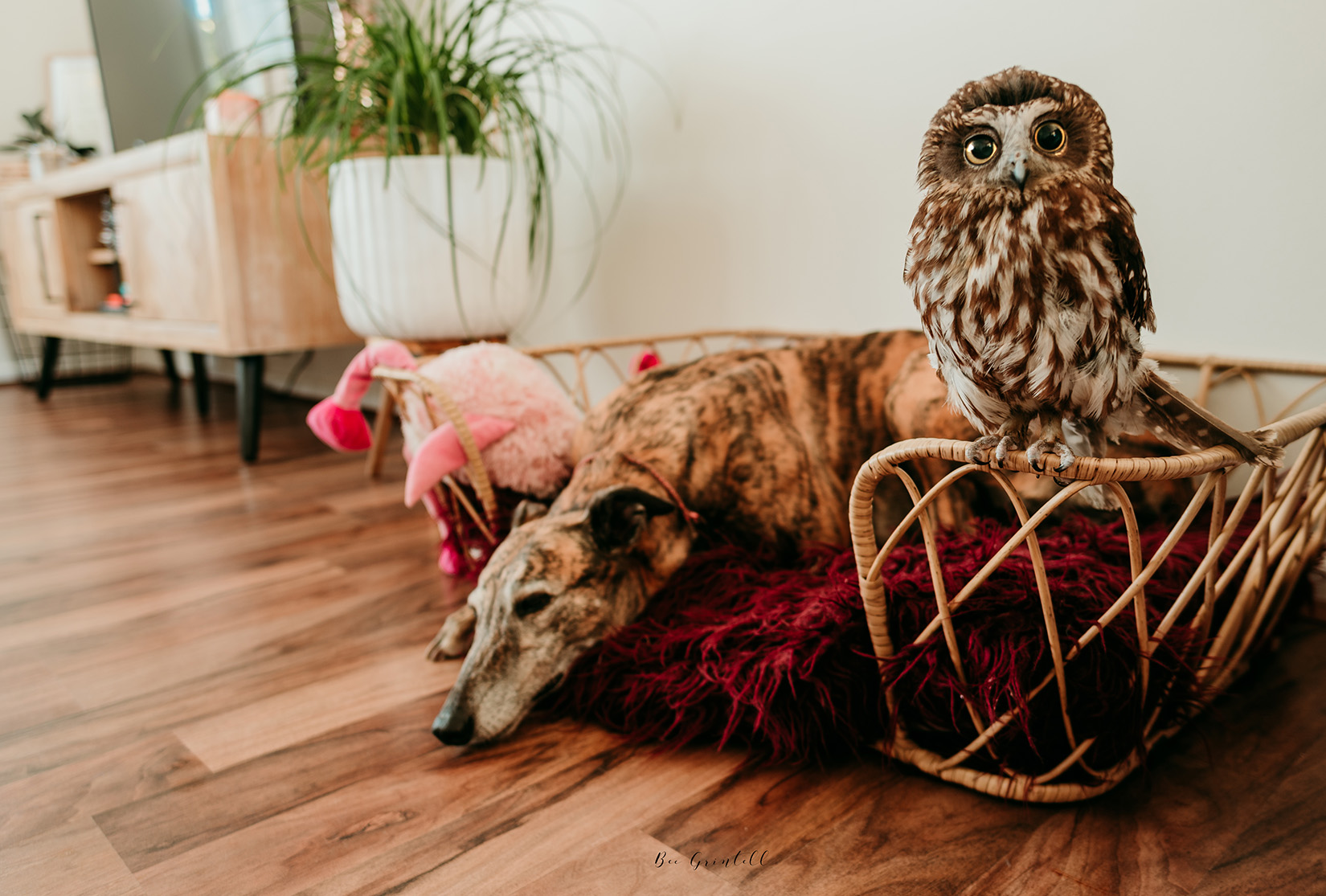
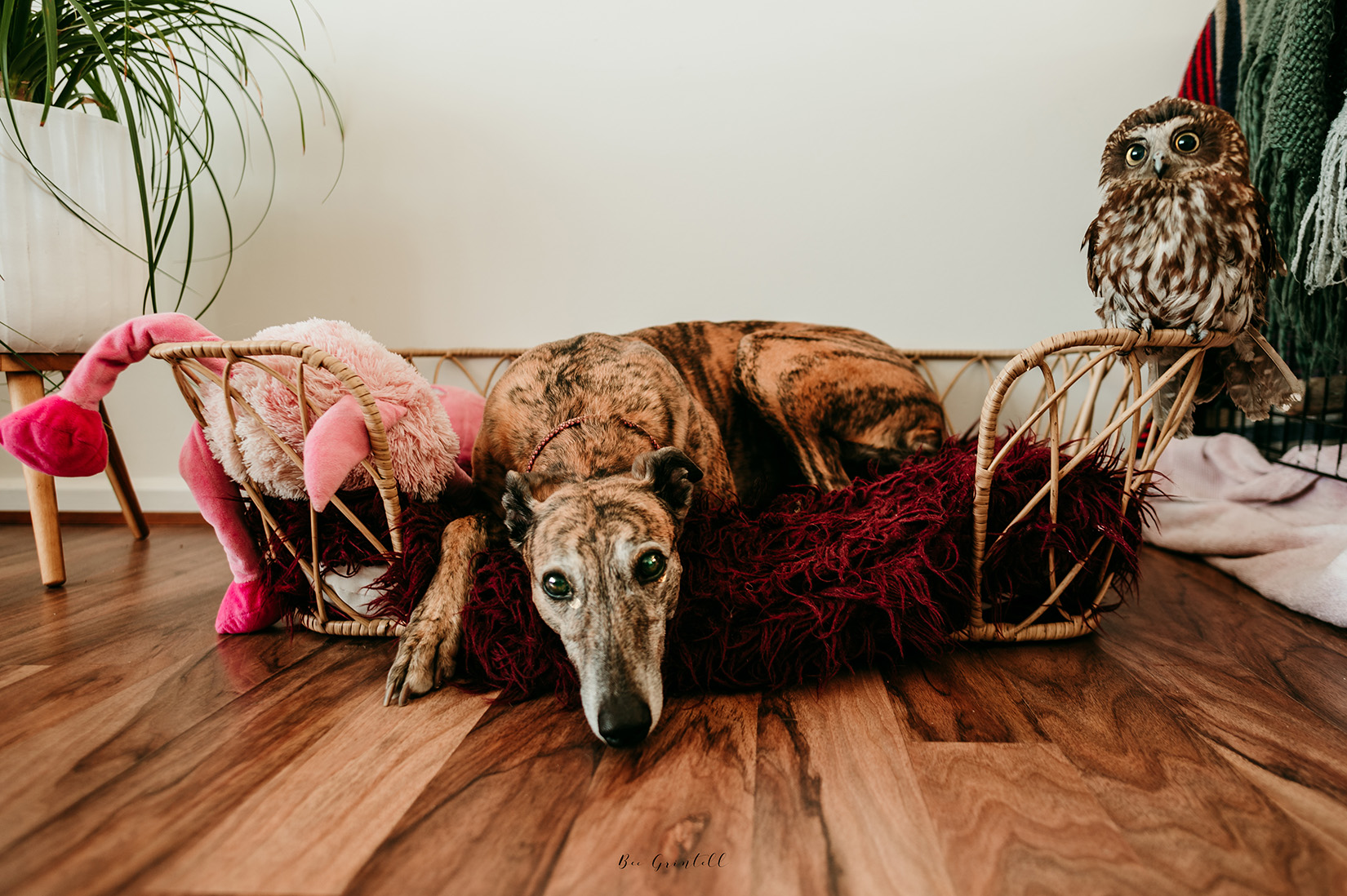
Roxy, an ACT Greyhound, once shared his bed with Hedwig, a Southern Boobook Owl. Hedwig had been hit by a car and was being attacked by magpies when Roxy’s owner rescued her.

During Hedwig’s convalescence, Roxy’s owner discovered the owl was an escape artist and would roost on the curtains or in Roxy’s bed. If Roxy was in bed when Hedwig landed in it, the Greyhound happily got out of bed to let the owl take ownership. Hedwig made a full recovery under a vet’s guidance and has been returned to the wild. Happily, Roxy now has her bed back. 

Greyhound Roxy with Hedwig, the Southern Boobook Owl 


ACT greyhound Patty Cakes lives with a cat, six chickens and a guinea pig. Patty Cakes’ owner said she went out one day and accidentally left the chickens in the backyard. When she came home, Patty Cakes was asleep in the chicken coop and the chickens were fine.

Theodore happily lies in bed with Morris
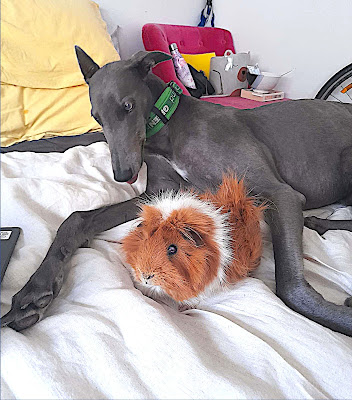
CPG also heard of several Greyhounds who have developed close bonds with guinea pigs. NSW greyhound Theodore lives with Morris the guinea pig. 

Despite the fact that Theodore has run 69 races in the past, he never chases Morris. The two of them love lazing about together on beds or lounges, while Morris occasionally nibbles Theodore’s toes.

Greyhound Jayda, also from NSW, loves to romp around in the grass with Toffee the guinea pig. Jayda even tolerates Toffee jumping on her and biting her. Meanwhile, Shay de Grey from NSW is happy to share her space with pet rats!

It is remarkable that Greyhounds adapt to living with many different pets, considering that during their time in the racing industry they are not socialised with other animals. There, the only creatures they are likely to encounter are small ones, such as rats scurrying through their cages, or slightly larger ones like rabbits, cats and possums which are used as live baits.

Unfortunately, a small number of ex-racing greyhounds will always have a troubled relationship with other animals, while some learn to accept other animals after some re-training. However, many require no training at all, peacefully engaging with animals they have never encountered before (but always check carefully with the rescue group from which you adopt your greyhound about its behaviour).


The reason for this is difficult to determine. It may be due to their easy-going personalities or it may be they have an innate understanding of what humans expect from them.

Many owners – even those who have owned dogs of other breeds – say Greyhounds have a special affinity with humans. They firmly believe Greyhounds understand and sympathise with human emotions. Furthermore, despite brutal treatment in the racing industry, rescued Greyhounds show remarkable resilience and an ability to forgive, which may be further evidence of their strong bond with humans.

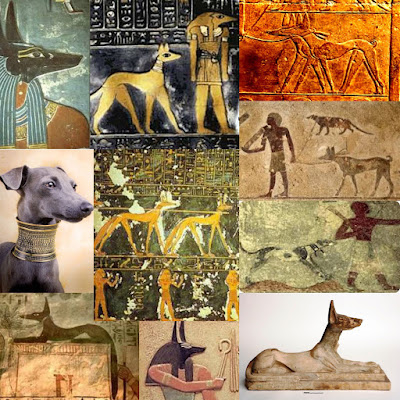
All this is perfectly understandable from an historical perspective. Greyhounds are one of few dog breeds raised for thousands of years as companions to humans. 

From the time they were revered by the pharaohs of Ancient Egypt, until more recently when they were the darlings of English nobility for several centuries, they have lived and worked alongside humans.

Meanwhile, the Greyhound racing industry has only been around for approximately one hundred years. 

While it’s true greyhounds have an athletic build and enjoy an occasional run, it’s doubtful they have the stamina or temperament for the brutality of intense racing and training. Consequently, thousands of racing dogs are injured, discarded or killed annually. Those lucky enough to survive, emerge frightened, confused and/or dysfunctional at the end of their racing careers.

Fortunately, most Greyhounds are able to shake off their hang-ups from racing once they are taken into loving homes. In fact, the speed with which they morph into contented, lazy couch potatoes, belies the claim of the racing industry – that Greyhounds are born to race.

One pet Greyhound owner believes many people feel a ‘duty-of-care’ to Greyhounds who have been systematically damaged by humans. It’s a sentiment apparently not embraced by those in the racing industry, who make a token effort to re-home the dogs they don’t want
.

Instead, many more Greyhounds are rehomed by charitable organisations and individual volunteers. Both groups work tirelessly with negligible financial help from the racing industry or governments.

Owners of pet Greyhounds also told CPG that living with Greyhounds is a lot of fun. They describe Greyhounds as ‘quirky’ or ‘goofy’ and say they typically do zany things for no apparent reason, such as spontaneous pirouetting or zooming around with, or without, squeaky toys.

Surely, the rightful place for any greyhound is on a comfortable couch in a loving home.

Greyhound Frankie chillaxing on the couch whilst a lorrikeet is pecking his bum!

written by Sue Skelsey, CPG volunteer, January 2022 for Australian Dog Lover 

About Coalition for the Protection of Greyhounds

CPG is a dedicated group of people across Australia who work together to inform the public about the cruelties of Greyhound racing – FacebookWebsiteInstagrammedia coverage.

Related Topics:


Dog Lovers Book Club - February 2022


Is the prospect of getting back to the office weighing you down after a drama-free holiday? Other than taking your dog for long hikes, the right book can also provide an escape from the daily grind. 

Find your next page turner in our February 2022 selection of the Dog Lovers Book Club plus a bumper selection of children's educational books for younger dog lovers to stimulate their imagination and expand their understanding of the world. 

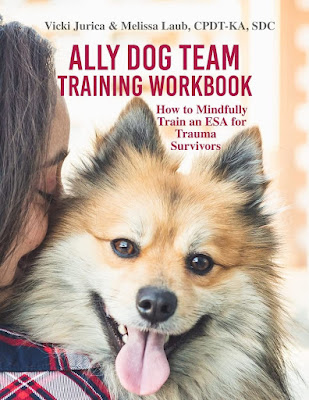
ALLY DOG TEAM TRAINING WORKBOOK
How to Mindfully Train an ESA for Trauma Survivors

by Vicki Jurica, Melissa Laub

The Ally Dog Team Training Workbook offers an exciting new way of mitigating post traumatic stress responses. By combining the healing modality of Mindfulness with Animal Assisted Therapy dog training, survivors of trauma can lessen the impact their experience has on their lives through deepening their relationship with their dog.

This comprehension workbook sets the foundation for survivors and their dog to develop a powerful relationship through learning the science of trauma and traumatic stress responses, the healing strategies within Mindfulness practice, emotional awareness of Self and dog, human and dog communication, and positive reinforcement dog training.


There is an art to any relationship between two sentient beings. Through active listening, respectful engagement and practice, survivors and their dog develop a training team partnership that positively impacts the mental health of both. It's through that relationship, healing occurs. 

From awareness to intentional response to trauma specific symptoms, survivors are empowered through mindful contemplation to tap into their own resiliency, supported by their dog who has also learned specialised skills to offer in support to their human.

Paperback, 434 pages
Publisher, Ally Dog Team Training LLC, 12th November 2021


Price: $41.95 at www.booktopia.com.au

WHERE THE LOST DOGS GO
by Susannah Charleson

An important and heartfelt exploration into the world of lost dogs and the power of reunion.

One in six dogs goes missing at some point, leaving bereft owners to search high and low, hang 'Missing' posters, check shelters, and hope for good news. But amid these grim statistics, countless happy endings are forged. Tails wag again. Best friends are reunited.


In Where the Lost Dogs Go, Susannah Charleson, author of Scent of the Missing, dives headlong into the world of missing dogs. The mission to reunite lost pets with their families starts with Susannah's own shelter rescue, Ace, a plucky Maltese mix who narrowly survived months wandering lost. While Susannah studies animal behaviour, lost-pet search tactics, social media strategies, and the psychology of loss, Ace also steps up for training. He reveals a nose for the scent of lost pets, and together they help neighbours and strangers in their searching. 

And when unexpected heartbreak shatters Susannah's own sense of direction, it is Ace - the shelter dog that started it all -who leads Susannah home. Inquisitive, instructive, heartrending, and hopeful, Where the Lost Dogs Go pays tribute to the missing dogs - and to the found - and to the restless space in between.

Paperback‏ : ‎ 320 pages
Publisher:‎ Harvest Publications, 16 June 2020

Price: $26.28 from www.amazon.com.au

FOR THE LOVE OF DOG
by Katti Strahsmeier-Stoller

Girl meets dog. Dog captures girl's heart. Girl starts veterinary school. Dog begins an eight-year battle with a rare genetic disease that teaches girl more about veterinary medicine than any textbook ever could.

For the Love of Dog
chronicles the friendship between Katti Strahsmeier-Stoller and her best friend Cooper, an unforgettable English Foxhound. While Katti trains to become a veterinarian, Cooper's triumphant spirit carries him through the tough hand life has dealt him.


A long struggle with his health, a tendency to follow his nose until he finds himself lost in the next zip code, an incident where an airline misplaces him in their supply closet for sixteen hours, a mischievous streak that sees him wolf down an entire Mother's Day brunch in one sitting-Cooper outlasts every setback with an inspiring amount of joy. 

Through it all, Katti does everything in her power to ensure a high quality of life for Cooper, culminating in those final moments when she performs CPR in an effort to save his life.

In times like these, who wouldn't love to curl up with a story about a dog who met every crisis with his head held high?


Paperback, 292 pages
Publisher: Three Meadows PR, 1st December 2021
 
Price: $25.42 from www.booktopia.com.au


ULTIMATE PUPPY TRAINING FOR BEGINNERS
The Best Book to Learn How to Train Your Puppy the Easy Way + 10 Amazing Homemade Dog Food Recipes!
by Linda Welton

After bringing a new puppy home to your family, the next important step is to train the puppy!

With this well-rounded book, you'll establish a mindful and meaningful relationship with your dog in a significant partnership based on trust, understanding, communication and mutual respect.

Some of the most interesting topics inside this book are:
✔️ Preparation Before Welcoming the Puppy
✔️ Approach to Dog Training
✔️ Tips for Making Dog Meals and Treats

Paperback, 122 pages
Publisher: Jabez Publishing Ltd, 6th May 2021


Price: $37.80 at www.booktopia.com.au

BOOK CLUB – KIDS’ CORNER

FETCH!
How To Speak Dog Training Guide

by National Geographic Kids

From the experts who brought you How to Speak Dog, learn tips and tricks to help train your best friend.

Whether teaching a puppy the basics, such as "sit", "stand", and "stay;" correcting behavioural problems; or training your pooch to perform more advanced tricks, this comprehensive guide will take you through all the steps to have your canine answering your call in no time. 

With the help of veterinarian Dr. Gary Weitzman, kids will bond with their pups through structured lessons that showcase easy-to-follow instructions and commands. Additional content introduces readers to Hollywood hounds, dogs on the job, and famous canines through history.

This "paws-on" guide is perfect for families who are bringing home their very first puppy, or seasoned dog owners who want to teach their long-time four-legged family member a few new tricks.


Paperback, 176 pages
Publisher: National Geographic Kids, 14th April 2021
For Ages: 8-12 years old


Price: $15.75 at www.booktopia.com.au

NEXT DOOR’S DOG GOES TO SCHOOL
by Gina Dawson, illustrated by Vivienne Da Silva

Grace wants to be able to do everything other children do and now that she has Roxie she can.


If Grace needs help, Roxie knows exactly what to do. With insightful illustrations and written in a sensitive and friendly style, Next Door's Dog Goes to School is about understanding the important role of dogs in our society and how they potentially change people's lives.

Paperback, 32 pages
Publisher: New Holland Publishers, 15th September 2021


Price: $19.95 from www.booktopia.com.au

HARRIET THE HEARING DOG
by Gina Dawson, illustrated by Kate Bouman

Lily is visiting Auntie Beth and Uncle Jake on their alpaca farm. This visit is particularly exciting because Lily is going to meet Harriet, Auntie Beth's new dog. Auntie Beth can't hear, and Harriet is her hearing assistance dog. 

At the farm, Lily looks on as Harriet lets Auntie Beth know about approaching visitors and household sounds and saves her from near disaster! 

Written in a sensitive and friendly style and beautifully illustrated, Harriet the hearing dog is a lovely educational story about the work of hearing assistance dogs. Gina Dawson has written several children's books about working dogs, including the Next Door's Dog series.

Hardcover, 32 pages
Publisher: New Holland Publishers, 17th January 2022


Price: $17.95 from www.booktopia.com.au

THERE’S A DOG IN MY BRAIN
by Caroline Green, illustrated by Rikin Parekh

A chaotic canine comedy that will have you barking with laughter.


When Danny made a wish to stay home instead of going to a family wedding, he didn’t expect to end up trapped in the body of a dog! Now he's stuck with Mrs Grout who loves cleaning – and hates dogs. In fact, she hates them so much that Danny's sure she's got something horrible planned for him...

Meanwhile, Dudley the dog is off on the adventure of a lifetime. He might look like a normal ten-year-old boy, but he has no idea how to behave like one. 

Drinking from the toilet bowl, chasing cats and licking loved ones is a sure fire way to get into Very Big Trouble.

Paperback, 128 pages
Publisher: Walker Books Australia, 6th January 2022
For Ages: 7 - 9 years old


Price: $22.90 at www.booktopia.com.au

PAWSITIVELY DAX
A Service Dog's Adventures

by Mike Dickerson

This book is based on the real life adventures of Dax who is an amazing 138 lbs. American Golden Retriever. Dax takes up his own row of seats on his airplane trips, car rides, and truck cabs. 

During his travels, he also enjoys an occasional "puppuchino" while smiling and making new friends along the way. His travels sometimes include visiting hospitals, churches, schools, or just waving to his drive-thru friends. 

You're guaranteed to smile in this adventure, make new friends, and learn all about the power of "Pawsitivity." There is never a dull moment, so come join Dax on his adventures including his fun holiday mischief!

Paperback, 36 pages
Published: 3rd December 2021

RRP: $24.50 from
www.booktopia.com.au

TY GOES TO THERAPY DOG SCHOOL
by Marsha Horshok, illustrated by Ginger Nielson

Ty is excited to attend therapy dog school. And like most children in school, he finds both joys and challenges. He makes friends, learns new skills and is tempted by distractions-- especially food! As he tries his best in school, an unexpected, serious incident puts Ty to the test. How does he respond?


Can he summon the discipline he needs to earn his graduation certificate from therapy dog school? Find out in Ty Goes to Therapy Dog School.

Hardcover, 36 pages
Publisher: Marsha A. Horshok, 8th January 2021
For Ages: 4 - 8 years old


RRP: $40.69 at www.booktopia.com.au

FOR LAIKA
The Dog Who Learned the Names of the Stars

by Kai Cheng Thom, illustrated by Kai Yun Ching 

By two of the co-authors of the acclaimed children's book From the Stars in the Sky to the Fish in the Sea: the moving and beautifully told story of Laika, the dog who learned the names of the stars.

Laika is an orphaned stray dog who lives in the streets of Moscow in the then Soviet Union. Although she is loved by her pack, Laika longs one day to learn the names of the stars, since she knows that all dogs become stars when they die - including her parents. One day, a Russian scientist named Vlad offers Laika the chance to travel to the stars by helping him with an important experiment, an event that will change the entire world.

Part fable, part dog story, part history lesson, young and older readers alike will find themselves captivated by Laika's brave and loving heart, and by her story, which holds important lessons about world peace, science, and the deep bonds between humans and every other creature with whom we share the planet. 

Hardcover, 40 pages
Publisher: Arsenal Pulp Press, 18th January 2022
For Ages: 3+ years old


Price: $36.75 at www.booktopia.com.au